Showing posts with label Trend. Show all posts

Monday, 18 March 2013

Moln-utbildning 23-24/5

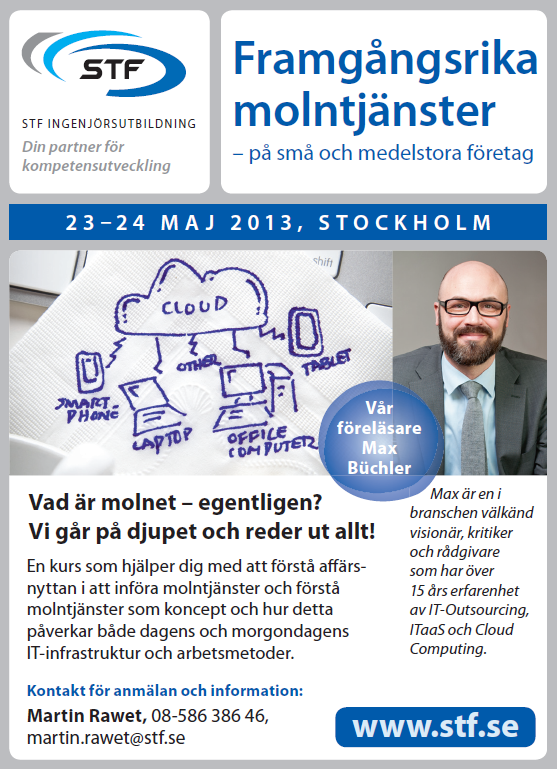
Den 23-24/5 håller jag i trådarna i den moln-utbildning som STF Ingenjörsutbildning AB erbjuder och arrangerar.


Vad är molnet - egentligen? Vi går på djupet och reder ut allt!
En kurs som hjälper dig med att förstå affärsnyttan i att införa molntjänster och förstå molntjänster som koncept och hur detta påverkar både dagens och morgondagens IT-infrastruktur och arbetsmetoder. 
Du utvecklar din beställarkompetens för upphandling av molntjänster.
Läs mer

Kontakta gärna Martin Rawet, STF, eller mig för mer information.

Thursday, 21 February 2013

Cloud ROI

Yes, there is a problem counting ROI in Cloud computing as Joe McKendrick (@joemckendrick) tell in the post Cloud Computing's ROI Increasingly Elusive, Survey Finds out on Forbes but I will continue to count value, not just numbers all the time. To be able to count value we have to understand Cloud computing and why it should be considered and planned for at the upper levels.

Short break out from Joe McKendricks post:
"Perhaps it’s a result of cloud becoming so tightly interwoven with the business that the potential results may be more far-reaching than a single process or two. Or, perhaps, cloud adoption and usage is expanding deeper into business operations at a faster pace than

Friday, 11 January 2013

Cloud (summ)arise 2012!


2012 was a remarkable year for me in social media. I’ve gained more than 1 000 followers…without any follow back strategy. More than 10’ visitors on the blog and good traffic and sharing on GP’s around the web. Not bad for a rookie I think. Big THANK YOU to all readers, supporters and followers. I truly appreciate it. And by the way… what a remarkable year it was for Cloud Computing.

And by the way...what a remarkeable year it was for Cloud Computing. Who’s not impressed by true cloud…when it makes sense, fulfill needs and works like it’s supposed to?

This is my cloud, and a bit of IT Ooutsourcing and management, summary for 2012.

Thursday, 29 November 2012

Collection 2 of great posts

It's time for my second collection of great posts. These four are, according to me, connected to each other in two ways: career and orchestration. I will link each post up, give you a short break out and add a short comment of mine.

First, when reading; think about how you can be a part of future IT, in the cloud, in hybrid solutions. Customers, whether to an IT department an ITO, MSP or appl operator,  need support from someone they can trust, their IT need to be orchestrated not only techy, its needed to be orchestrated on all levels

Tuesday, 27 November 2012

Collection of great posts

Some great and even important posts from yesteraday. You should read them to, it might be good for your business or career.

IT sourcing models are shifting: A Deloitte perspective by Karl Flinders (@karlfl). Short break out:
""Are we witnessing the death of the 'mega-deal'? Is it going to get even tougher for the traditional one-stop-shop IT Outsourcing (ITO) houses? Why are so many organisations re-thinking traditional sourcing models all at the same time?


Thursday, 8 November 2012

'Doomed?' on Outsourcemagazine

My latest post 'Doomed?' on Outsource Magazine is out.

Breakout:
"I ask myself, will it be a true shift where traditional IT outsourcing providers* becomes outmaneuvered by smaller service provider, cloud brokers, in-house IT departments and non IT service providers acting as orchestrators of future hybrid IT? A shift caused by:
  • Smaller SPs are able to change when the market does. Faster and shorter step to new decisions. 
  • Smaller SPs are able to operate, manage and orchestrate solutions earlier exclusively reserved the larger ITO providers. 
  • Non-IT service providers from mature branches bring money, resources and trimmed processes in to a sometimes immature IT world. 
  • In-house IT departments are able to orchestrate their IT solutions. They don’t have to focus on fundamental operations provided by IaaS, PaaS and A-/SaaS; they are able to concentrate on core/special services and work more innovative to bring value to core business. To become the internal trusted cloud broker to avoid de-centralised procurement/adoption of products and services. 
  • The act of “Fat and happiness”: instead of working innovative (know, predict and tell what the customer needs in the future) ITOs only focus on now! 
  • ITOs don’t use partnership to build success. They build everything on their own." 
Tell me what you think on Outsourcemagazine, here on the blog or just send me a mail.


ITO's, SP's, non-IT SP's, "end-customers": Of course MMind is able to discuss in detail how your business can deal with this.


Tuesday, 28 August 2012

Well, do you understand Cloud?!

Commented the post Does the US understand cloud computing? on ZDNet by  (@ZDNetCharlie).

Short break out:

When asked what "the cloud" was, 29 percent said "a fluffy white thing", whereas only 16 percent connected the phrase with a network used to store, access and share data across Internet-connected devices.
Cloud computing was found to be widely misunderstood. The survey found that:
  • 51 percent of respondents, including a majority of Millennials, believe stormy weather

Tuesday, 22 May 2012

Response to a Twitter Q from @opendatacenter

My response to a twitter Q from @opendatacenter about Info Security’s post Security is driving Cloud adoption.


Here are a couple of reasons SMB’s might trust cloud more than Ent (no specific order):
  1. SMB’s has shorter way to decision and policy changes.
  2. SMB’s hasn’t same expensive and heavy solutions to drop (kill darlings)

Thursday, 8 March 2012

5 innovative bullets

Today I visited the NetApp event on Berns, Stockholm. The great closing session was by the Swedish trendspotter and futurologist Magnus Lindkvist (@TrendyMagnus (worth the follow)). He gave us 5 innovative bullets and keys to success (translated):

- look forward
- mix ideas
- be experimenting
- recycle failures
- be patient

A bit cliché but; think out of the box!

Wise!

Thank you NetApp for a great event.

Monday, 5 March 2012

End of PC era?

Earlier this evening I commented the teasing post "Windows 8 Proves That The Death Of The PC Is Greatly Exaggerated" by Erik Kain (@erikkain) on Forbes.

Short break out:
"Every now and then we hear rumors of the death of the PC. The rise of the tablet, and especially the iPad, makes these rumors far more common. Take this article in the New York Times, titled “As New iPad Debut Nears, Some See Decline Of PC.”

To be fair, it’s a reasonably balanced article, noting in the end that it’s much more likely that tablets and PCs will simply become more indistinguishable.

Friday, 24 February 2012

BYOD-commented...I couldn't resist

Sorry, but I couldn't resist to comment another BYOD-post. Why? Because it was really good and spot on it why BYOD, not consumerization, might not be thats success everyone's buzzing about.

The post: 'BYOD: Good for whom exactly?' by Steven J. Vaughan-Nichols on Computerworld.

Short breakout:
"It would be one thing if companies paid for users' personal equipment and services, but I really fear BYOD is becoming just another way to shift costs off the company budget and onto employee's backs. Worse still, I can see BYOD actually blocking people from being hired.
So, even though I'm a BYOD user through and through, I can't really get behind the idea that BYOD is that great an idea for everyone."
My comment:

First; great read.
 
I’ve promised myself to not comment or write any more “negative” posts about BYO. I don’t want to become the “old grumpy guy”, but BYO has become my windmill (Don Quijote) for the moment. But finally I’ve found some guys who been doing some thinking, beyond the possibility. My point is that almost everyone points to the choice of freedom but never takes the time to think of the possible consequences of implementing a BYO-program.
 
My biggest concern is when the possibility becomes a demand. When the employer demands you to bring a device and the different between keeping the job is a golden support contract connected to the device.
 
I’m pro consumerization and evolution but I’m not that keen to BYO. Instead of a BYO I think companies should consider to implement a wider device policy a CYO (Choose Your Own)-program where employees can choose from a ending list of devices (smartphones, pads, PC, Mac etc.).
 
If you want to read more about my BYOD opinions you can find them on inmaxmind.com. Latest post is the “Last windmill attack!”. But it seems it didn’t become the last one… I couldn’t resist… ;)
 
Short break out from “Last windmill attack!”:
 
“My biggest concerns with BYOD are:
- When it becomes an employer demand that you should bring it and no longer is a possibility.
- Who are able to bring their devices – “the cool guys”?
- Will the support contract connected to your device be equal to keeping your employment or not?
- The IMHO administrative mess.
- Why people should bring devices. Don’t employers earn the money to provide it, isn’t that included in budget? Shouldn’t then the employer get paid and the company board higher the company revenue demand?
 
With these bullets I stop the main attack. But please keep them in mind.Other people’s concerns seems to be more at risks like management systems, company data access on private devices and how to access the company services. My opinion; these are all techniques and policies issues which can be solved.”

Friday, 10 February 2012

Last windmill attack!

If you’ve been following me you most probably noticed I’m not that keen to BYOD. You then also know I written a 3 step BYOD-story and commented every BYOD post I’ve met.


I’m getting a bit tired of myself in this subject know so I won’t write another article in my “crusade”, my attack against thee windmill BYOD. So this will be my last windmill attack (Don Quijote). I might comment some posts though.

In this last post attacking BYOD I will also defend it.

My biggest concerns with BYOD are:

Sunday, 29 January 2012

Comment on ZDNet post

Last night I made a comment on ZDNet to the post 'Your next laptop could have Microsoft's Kinect built into it' by Sean Portnoy.

Short break out:
"Microsoft is finally delivering on its promise to bring Kinect to the PC with official support, but most people would probably assume it would be most useful with a desktop. Nonetheless, it appears that the motion-control technology could also show up on portable systems."

Wednesday, 25 January 2012

Another BYOD-post commented

BYOD must be my windmill (Don Quijote)! ;)

Added a comment to the post 'Cisco: Nearly half of IT managers still against BYOD trend' by Rachel King on ZDNet.

Short break out:
"Tablet computing in the enterprise world is about to hit a major turning point in 2012, but there are definitely some serious roadblocks ahead, according to a new report from Cisco.

Tuesday, 17 January 2012

BYOD 3 – When the possibility becomes a demand

Humans are by nature creatures of habits and have been for ages. They like to know what to do tomorrow, next week and next month. Some people like it more monotonically some like it more varied. During the last decades the staffing business and independent contracting has made big entrances to the market. This type of employment fits some people better some worse. (I won’t go into the staffing business market and independent contracting but on a brief level I think they are devastating to people. Read my first sentences and you understand why. ) Normally young people are more or less forced into this type of employment. On the other hand it can be a gold mine if you are really good on something but then you most probably also has a buffer when between assignments because of the good salary. But in most cases people like to be permanently employed. It is safer and you know what to do tomorrow, next week and next month as long as you do your work, behaves and the company works ok.

Thursday, 5 January 2012

Comment to Ken Hess ZDnet post 'Consumerization: The New Colossus'

3rd of January Ken Hess (@kenhess) published a post named 'Consumerization: The New Colossus' on ZDNet. Worth reading, also the comments. Added this comment to the post today:

I do agree with @aep528 in some cases. Also agree with many of the other comments, concerns and hurrahs. On my blog I'm writing a 3 step story about BYOD where I've published step 1 and 2. I'm really not so in to BYO, I really can't see the point and it will cause an administrative mess. Though my biggest concern is, which my step 3 will be about; when the possibility becomes a demand.

The demand might be a consequence of @aep528's company benefits. What will happen when companies demand you to BYO? I think as Ken say independent contractors will increase and as a dramatic consequence a personal "gold" service agreement attached to your device might be the key to keep your employment or not. And I think this will be a bigger problem than we might think. Why? There are a lot of employers who always try to use laws and systems at a maximum and with a mind set of “is there a possibility – use it”. In Sweden, where I live, there are rigorous rules of how and when you can fire somebody but firing will be easier if having independent contractors. And this will cause disorder in the society. No, I don’t mean BYOD will turn all things upside down but it will make people upset.

Also consider there are a lot of groups who never will afford bring their own. As I say in my part 2 I think BYOD is a possibility for “the cool guys”.

The future employers have to be attractive to attract good people. One way is to allow BYO. But if I was a good prospect to employee I would say “please give me the device” instead of asking “can I bring my own?"

Wednesday, 21 December 2011

Trendspan (in Swedish)

Min artikel om trender som publicerades i TeleComputing News nr 4 2011. Några ankor och flowproblem märkte jag vilka jag ber djupt djupt om ursäkt för. ;)

Vad som är på gång

I takt med att marknaden för IT-tjänster och outsourcing av IT-funktioner förändras så förändras även kraven på aktörerna inom outsourcing. Sedan en längre tid tillbaka har förändringen skett från att tillhandahålla co-location och sourcingtjänster till att tillhandahålla managerade tjänster - sourcing providern har blivit en managed service provider (MSP). I denna artikel ska jag lista och försöka beskriva de trender det talas om mest på marknaden.

Generellt finns det som vanligt en tendens att det är många nya benämningar på saker som egentligen funnits sen en tid tillbaka. Det som är tydligt är att gränserna är rätt suddiga och man kan alltid peka på att ingen har fel och alla har rätt.


Moln, SaaS online

Sedan ett par år har online- och molntjänster samt SaaS, med alla dess underkategorier, starkt avancerat på marknaden och det finns idag inget som säger att det kommer att avta. Vissa tjänster kommer exempelvis inte vara tillgängliga för lokal installationer utan endast vara tillgängliga i molnet som en SaaS. Internet är en utmärkt bärare för tjänster, varför skulle man inte nyttja den här tekniken? Däremot kommer hypen avta, det kommer bli en mer gängse standard och vissa cloudwashers/wishclouds kommer att försvinna. Det är helt enkelt många som söker lyckan. Något man inte ska glömma är att många system och funktioner kommer att behöva vara kvar lokalt hos företagen eller husera i privata moln hos MSP:s, allt kan inte flytta till molnet, hybriderna är ett faktum.
  • Hybrider Tänk en hybridbil, mix av ex el och etanol. Hybrid IT är mix av moln (ex privata eller publika), system lokalt på företaget och tjänster från en MSP. Hybrider kommer bestå länge, kanske för alltid.
  • On-demand Behoven på flexibla betalningsmodeller och att avropa tjänster vid behov (On-demand) har ökat för att tillfredsställa krav på kostnadseffektivitet. Det här är väl egentligen ingen ny trend men den fortsätter att öka i efterfrågan.
  • IT Ecosystem Hett, men i grund och botten handlar det om att leverera produkter som tjänster och att produktleverantörerna (mjukvara) team:ar upp sig med solution providers, som ex TeleComputing, för att leverera produkten som en tjänst. Från ax till limpa och tillbaka till ax…få det att gå runt. Inte så knepigt som det låter flashigt.


Standard blir anpassat, anpassat blir standard

Jag uppfattar, eller kanske snarare förutspår, att det finns en tendens att standardiserade tjänster ökar och att kundanpassade avtar. Alltså det unika avtar medan det ”fyrkantiga” blir mer anpassningsbart. Av ekonomiska och integrationsmässiga skäl sker denna svängning, det är för dyrt och komplext att specialanpassa. Man behöver anpassa organisationen mot tjänsten istället för tvärtom, det är en omställning men den behöver göras. Samtidigt så blir de standardiserade tjänsterna mer anpassningsbara med tydliga gränssnitt för att integrera två eller flera system.

Virtuella klienter

Sist men inte minst vill jag slå ett slag för virtuella klienter. Och nej, det är absolut inte för att jag arbetar på TeleComputing. Virtuella klienter har ett oförtjänt dåligt rykte, ett rykte som inte på något sätt är aktuellt på marknaden idag, kort sagt ingen pratar om de dåliga ryktena för de finns inte. Ryktena baserar sig på användande av gamla versioner med gammal funktionalitet, dåliga installationer och konfigurationer, dåliga kommunikationslänkar mm. Kommunikationslänkar är inte längre ett problem, bandbredd finns både i marken och i luften och det till mycket rimliga priser. I o m molntrenden så är det naturligt att även köra virtuella klienter över internet. Citrix, VMware, Microsoft och andra leverantörers produkter som finns idag är inte samma sak som det som fanns 2005. Installationer och konfigurationer går att göra rätt. Virtuella klienter är hett och kommer att öka. Det finns egentligen ingen anledning att tro något annat – det fungerar riktigt bra! Sen; vare sig man gillar BYOD så är virtuella klienter, enligt mig, i princip ett måste. Kom förbi och testa nya OnDemand om jag inte lyckats övertyga.

Det här är bara några av sakerna som rör sig på marknaden. Det pratas mycket om moln men det gäller att koka ner vad som är viktigt för just ditt företag. Det är det ex TeleComputing ska vara ett stöd i, en rådgivare och partner.

Ökade krav på outsourcingleverantören

Alla saker som händer på marknaden, vad som är aktuellt nu och kommer att öka i framtiden ställer som tidigare nämnts krav på aktörerna. MSP:n behöver bättre förstå behoven företagets core business ställer och hur de tillfredsställs rätt och effektivt.

Tekniken för att leverera IT som tjänst är oerhört viktig att den är säker och stabil. Den behöver även vara modulär och flexibel för att kunna hantera tjänster från olika leverantörer och källor samt genom olika tekniker men även till olika typer av enheter i och med consumerization-trenden BYOD (Bring Your Own Device). Tekniken är dock ”sekundär”, missförstå mig rätt. Tekniken är oerhört viktig för IT-avdelningen, MSP:n och molnleverantören. För företaget är det funktionen och tillgängligheten som är det viktiga. Detta ställer krav på aktörerna att ha bra enkla och förnuftiga fakturerings- och beställningsfunktioner samt framför allt de mjuka tjänsterna såsom Service Desk, ändringshantering, samordning och samverkan. Det är inom dessa områden avgöranden kommer att stå om att fortsätta att vara en aktör på outsourcingmarkanden eller ej. Kortfattat;
  • Aktören måste kunna beskriva hur en tjänst bringar nytta och ”killing pains” för kunden. K: ” What’s in it for us?”
  • Aktören måste kunna beskriva och motivera varför en bakomliggande föråldrad teknik är nödvändig att uppgradera för att möta framtiden bäst.
  • CIO:n på företagen går mot att vara mer affärs- än teknikinriktad. Tekniken är aktörens angenäma ”bekymmer”, och den ska förvandlas i business för CIO:n.
  • Aktören ska vara företagets öra mot marknaden samt vara en del i och bidra till företagets ökade effektivitet och produktivitet.
  • Aktören ska hjälpa kunden att vara en attraktiv arbetsgivare. Människor, och framför allt unga människor, ser mycket på vad företagen kan göra för dem. En attraktiv IT-miljö är en viktig del av den.
  • Aktören ska vara den betrodda rådgivaren. Partnerskap mellan företaget och aktören är absolut avgörande för en lyckad IT as a Service. Glöm inte; it takes two to tango.

TeleComputing News No 4 2011 (in Swedish)

TeleComputings News No 4 2011 (in Swedish) is out!

Posts by and about me.

Enjoy!

Tuesday, 13 December 2011

BYOD 2 – A possibility for "the cool guys"

In the first part (BYOD 1 – What is, why trend) I wrote about some basics about what BYOD is and why it has become a trend. We also got some information about what vendors, analysts and journalists say and think about it. Now let's look into for whom is BYOD good for: BYOD 2 - a possibillity for the cool guys.

First; I won’t further discuss this but employers who are having a policy which says “here you have some money, go by your own” is to me a employer who don’t have an attractive device policy. They are just struggling to be an attractive employer and have a weak policy and management level, which is controlled by the employees. It will only create an administrative mess. Just think about simple thing like if the employer buys a device not good enough, who’s responsible to return or upgrade it? And when someone ends their employment after 1 month or 1 year, before the depreciation time ends, should the employer give the “so personal” device to someone else? Just skip this way of BYO, its buy your own and it’s not good for anyone more than the hardware vendor. Let’s focus on the BRING your own.

For vendors of pads and smartphones it’s definitely worth pushing BYOD. But this market will increase whether or not BYOD-model will be implemented by the employer.

For vendors of virtual desktops it will be a continued golden era. My opinion is that virtual desktops (VD) have a, undeserved, bad reputation, this because of bad tradition of lazy communication links and old versions of VD’s. Virtual desktops are a really good way to connect to the employer’s palette of services. With the newer versions from Citrix, VMware, Microsoft and all the others you can get a really nice employer and employee user experience. I will get back to VD’s in a later post.

For vendors of management software the development have to proceed with or without the BYOD. The market of pads and smartphones + the market of VD’s increases and companies have to orchestrate and provide desktops/apps to many different devices.

Fine, the business seems to grow for the main segment of vendors to BYOD solutions…with or without BYOD.

But – if you look at the BYOD trend in general, not on pads, VD’s and management systems, how big is this market and for whom is it for? Sorry, but I think we expect too much of BYOD. I am not going to tear every good reason of freedom down. I am sure I have more than 10 killer reasons why not BYOD. Neither I will embrace why you should allow and implement BYOD. I will focus on some basic reasons why it might be complicated for BYOD to grow and become a legacy standard in delivering IT. Also, and probably the main reason, why it will be difficult to see wins for both employees and employers.

People, by nature, will try to save money so they will try this, they will claim it is a working tool. And - who wouldn’t?! In Sweden and many other countries you do a yearly income declaration. In some cases you are able to withdraw private costs for clothes and tools you need to use in your work. How will tax authorities handle this? I’m quite sure the tax authority will say no no pointing “your employee agreement doesn’t say you should bring your own and we expect your employer should provide you with the device you need.”

Some industries will never ever support own devices. Banks, defense, audit, research in medical and technique etc. Just think about the rigorous security programs and policies companies have to secure their business from attacks, industrial espionage etc. The effort to achieve a secure BYOD-program is too high both from a risk and a cost perspective.

In the first part I talked about Apple being the guys to thank for BYOD. Windows still has a devastating majority of all the professional desktops around the world. But many employers now more do allow, or start to implement, Mac in their standard device portfolio. And when this is implemented at a reasonable level many Mac users most probably want a client the employer pays for instead of bringing their own.

The reason I started to think about BYOD was for this reason; who are the BYOD targeted people and what happens when the bringing becomes an employer demand? I will talk about the employer demand in part 3, so first; who are the targeted people? The people I think about works in areas like IT, market and sales. Not seldom talented with creative skills. Not seldom young. Not seldom with a quite nice salary. The privileged people, the cool guys. How about all the others? Where the absolute mass of people reside = where the margin and all the easy money resides. Note! I haven’t done any research. I am struggling to find other users but it’s difficult, and don’t think I haven’t thought about this. How many are there in industries like industry, health care, general offices – all the “normal” people, the mass, the money? No, they won’t bring their own devices to work – they won’t. If a nurse was allowed to use his/her iPad to read journals on the round he/she wouldn’t – it’s in the walls.

To me BYOD is something for the cool guys. Success stories should include easy money, easy money won’t be found at the cool guys’ level– they are far too few to give big business. Save the BYOD campaign money to something better.

Until part 3 remember; if you bring your own you own it and are responsible for it!
"2012 Threat Predictions: An Industry Roundup" by Infosecurity

Read a great article from Infosecurity. A must read for CIO's, IT guys and all others. You should be informed and up to date with this. Read the full article: "2012 Threat Predictions: An Industry Roundup"

Breakout:
"We asked more than 20 security companies and security experts for their threat predictions for 2012. The intent? To find what the security industry in general expects to see next year. The results are not scientific, but certainly indicative of what business can expect in 2012.

We should start with a caveat: Many of these threats should be combined. For example, social engineering threats will often be focused on social media; the ‘bring your own device’ (BYOD) threat is closely linked to the mobile threat; infrastructure attacks will likely use APTs, and so on. Nevertheless, the overall picture is a pretty good overview of the evolving threat landscape for 2012.
|
1: Mobile Malware
|
2: The APT
|
3: Social Engineering
|
Finally...
One last comment. Despite all the threats and warnings and predictions you’ll come across over the next month, remember this: it will be the threat that you didn’t expect that gets you."

Overview:


All from Infosecurity